A WiseCost case study. By Alfonso Aguilera, Founder, WiseCost.
WiseCost builds compliance software for small U.S. government contractors. We connect to QuickBooks Online and handle the timekeeping and labor-distribution work that QuickBooks was never designed to do. In March 2026 we filed a provisional patent application on the core method behind that work. Xsensus LLP prepared and filed it for us. This is the short story of what we protected and why we thought it was worth protecting.
The problem we set out to solve
Small government contractors have to prove how every employee spent their time, split labor between direct and indirect costs, and post the result into their accounting system in a way an auditor can follow. Most of them do this in spreadsheets, by hand. It is slow, it breaks down past a handful of employees, and it leaves almost no trail. The enterprise tools that solve it properly cost tens of thousands of dollars and require replacing QuickBooks entirely. We wanted a third option: keep QuickBooks, and add the compliance work on top of it.
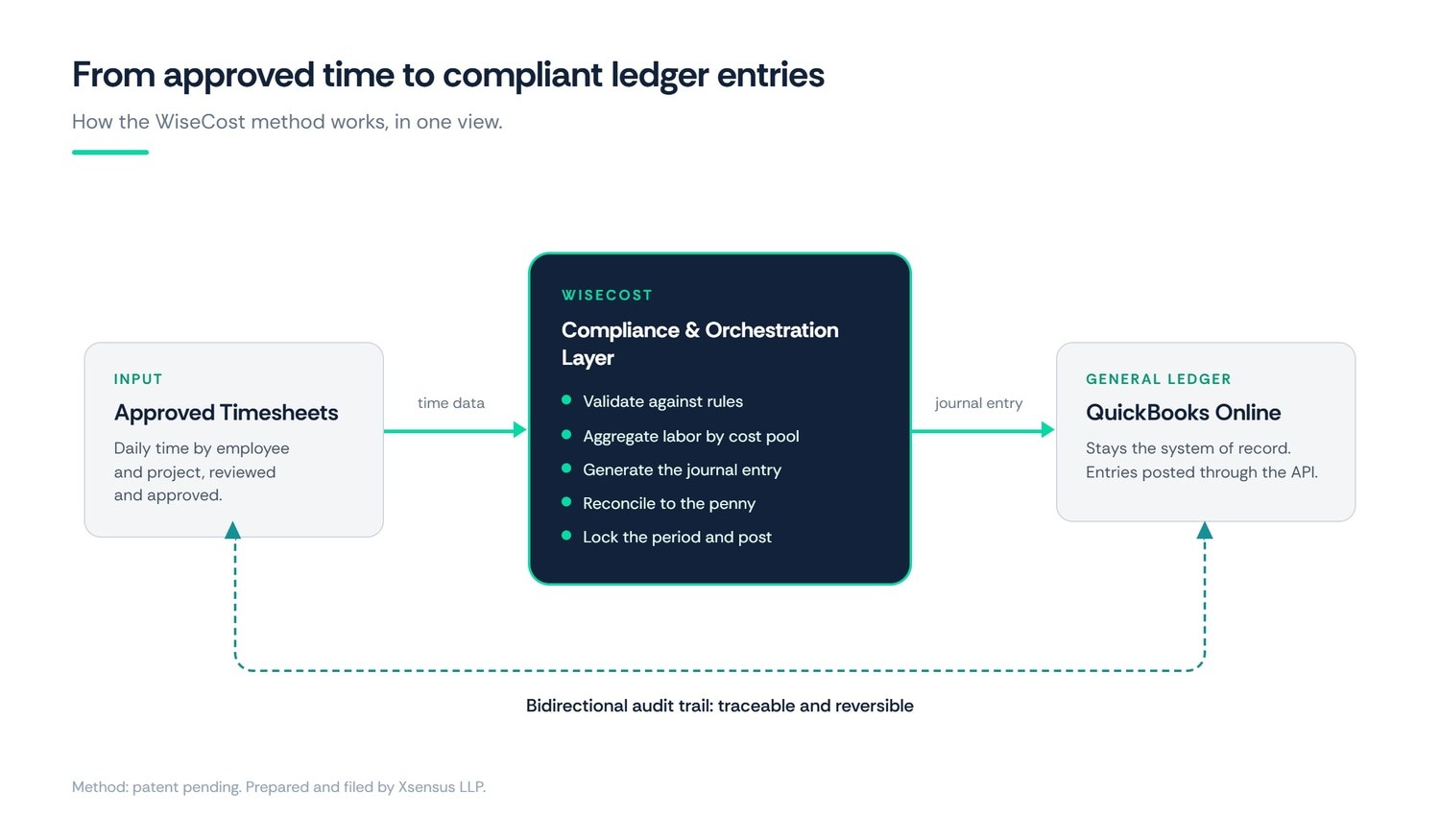
The WiseCost Method, illustrated
What we filed a patent on
The method covers how approved timesheets become compliant, traceable accounting entries in an external general ledger like QuickBooks Online. In plain terms, a middle layer sits between time tracking and the accounting system. It checks the data against a set of rules, groups labor by employee and cost category, turns it into a journal entry, posts that entry to QuickBooks, and keeps a two-way link between the original hours and the posted entry.
Along the way it solves a small but stubborn accounting problem. When one person’s cost is split across several contracts, the rounding rarely lands exactly, and the pieces do not add back up to what the person was paid. The method reconciles those splits so the total matches the payroll cost to the penny, every time. We call it True-Penny.
If a period has to be reopened, the original entry is never deleted. The system reverses it and preserves the record. That last part, the traceable and reversible audit trail, is the heart of it. An auditor should always be able to answer who worked on what, who approved it, and where it landed in the books.
Why we chose to protect it
Filing was a deliberate decision, and I think it is the part of this story that matters most for other early founders. A lot of what we build is a workflow: steps, rules, and the way data moves between systems. It is easy to assume that kind of software is not the sort of thing you protect. In our case it was. The approach was not obvious, it took real engineering to get right, and it is the core of what makes the product work. We filed a provisional patent application, which gives us an early filing date and lets us describe the method as patent pending. It is not a granted patent, and it does not give us exclusive rights on its own. We say patent pending, never patented, because that is what is true today. Even so, that early filing date is worth having.
Protection also does something on the commercial side. For a small company selling into a compliance-heavy market, credibility matters. A buyer choosing a labor-distribution or DCAA tool is trusting it with numbers an auditor will later inspect. A vendor that has invested in protecting its method is showing that the approach is its own, not a thin copy, and that it plans to stand behind how the product works. If you are building something you believe is genuinely yours, the question of whether it is worth protecting is worth asking early, before the details are public and the window starts to close.
The takeaway
Xsensus LLP handled the filing from drafting to submission, and helped us see that a workflow this specific was protectable in the first place. If you run a small government contractor, or advise one, you can see how the method works at WiseCost.
Alfonso Aguilera is the founder of WiseCost, DCAA-compliant job costing for government contractors, built on QuickBooks Online.