For the second consecutive year, Xsensus sponsored a student team in “Jumpstart Your Engineering Career,” the summer program run by the Cyber-Physical Systems Engineering group at the University of Maryland’s A. James Clark School of Engineering. Members of the firm attended Demo Day in August at the Universities at Shady Grove to see what the students had built.
The premise is demanding. Rising high school seniors arrive with an interest in cyber-physical AI and five weeks on the calendar. In that time they have to find a real problem, design something that addresses it, build it, test it, and then stand in front of a room and defend it. Eleven teams made it to Demo Day.
Team WeCycle
The team Xsensus sponsored was WeCycle, and they went after something most people run into weekly and quietly get wrong: which bin does this go in?
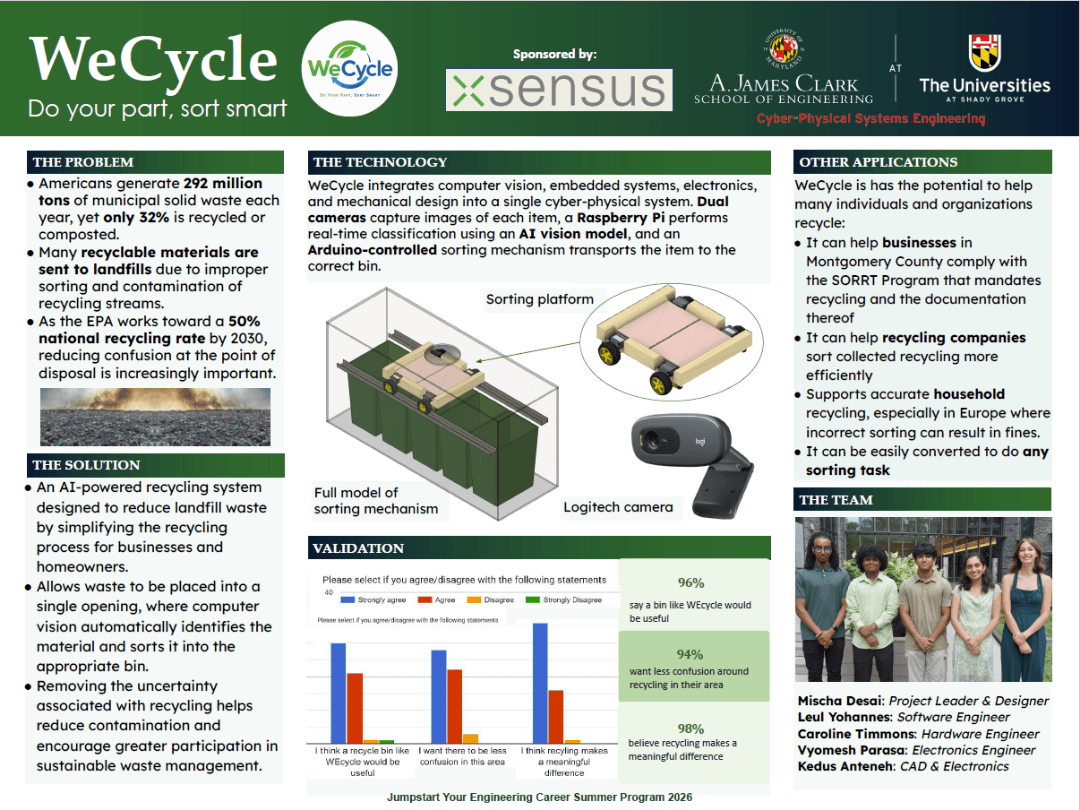
Americans generate 292 million tons of municipal solid waste a year, and only about 32 percent of it is recycled or composted. A great deal of otherwise recyclable material reaches a landfill for no better reason than that someone guessed wrong at the point of disposal, or that a single misplaced item contaminated an entire stream. With the EPA working toward a 50 percent national recycling rate by 2030, the distance between what could be recycled and what actually is has become an engineering problem worth solving.
WeCycle’s answer was to take the decision away from the person holding the trash. Their prototype accepts waste through a single opening. Dual cameras capture the item, a Raspberry Pi runs an AI vision model that classifies the material in real time, and an Arduino-controlled sorting platform carries it to the correct bin. Computer vision, embedded systems, electronics, and mechanical design, integrated into one working cyber-physical system, in five weeks.
They also did the part that inexperienced engineers most often skip: they checked whether anyone wanted it. In the team’s user survey, 96 percent of respondents said a bin like WeCycle would be useful, 94 percent wanted less confusion around recycling in 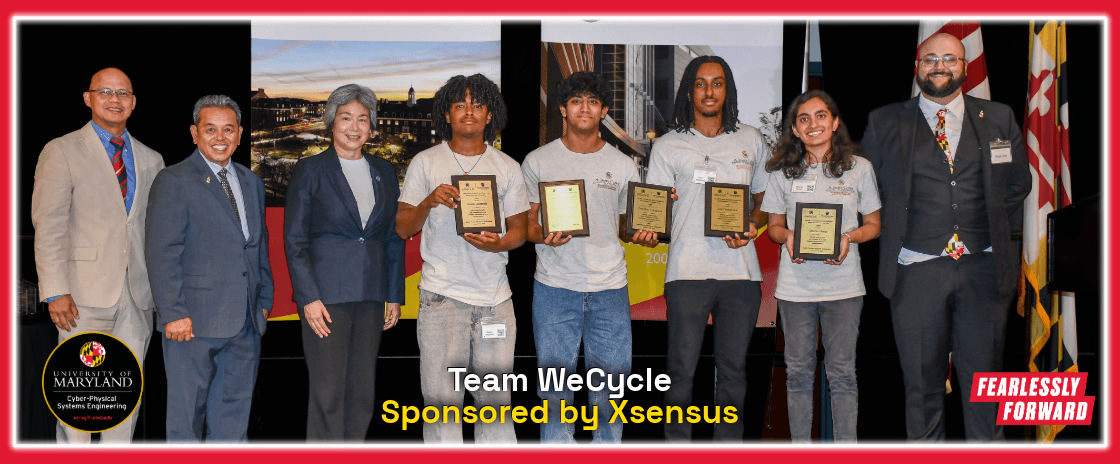 their area, and 98 percent said recycling makes a meaningful difference. The team mapped out where else the platform could go, too, helping Montgomery County businesses meet SORRT recycling and documentation requirements, helping recycling companies sort collected material more efficiently, and adapting the same mechanism to sorting tasks that have nothing to do with waste at all.
The WeCycle team was Mischa Desai (project leader and designer), Leul Yohannes (software engineer), Caroline Timmons (hardware engineer), Vyomesh Parasa (electronics engineer), and Kedus Anteneh (CAD and electronics).
The rest of the room
WeCycle was one of eleven projects, and the room was full of ideas that would not have looked out of place in a client meeting.
The winning team built a rover that travels through underground sewer pipes and inspects them, so crews can find and clear obstructions before a blockage becomes a flash flood. That one landed close to home. Flash flooding near our old Alexandria office claimed three or four of our cars over the years, and it is not hard to imagine what an early look inside those pipes would have been worth.
Other projects included:
- Bike E-Buddy — a rear-facing radar that measures the distance and speed of cars coming up behind a rider, paired with handlebar vibration motors that deliver turn-by-turn GPS cues so the cyclist never has to look down. Brake lights and turn signals handle the other half of the problem: telling drivers what the rider intends to do.
- Dot Bot — a portable Braille label maker, inspired by a team member’s blind friend. Users type or speak a label into a companion app, and push-pull solenoids emboss the raised dots onto adhesive tape, making it possible to label medications, food containers, and anything else on demand.
- Galea Guard — a football helmet that reports what just happened to it. Accelerometers, gyroscopes, and pressure sensors capture the force, rotation, and location of an impact and send it to an app in real time, giving coaches and trainers objective data in the minutes after a collision rather than a guess.
- LitAloud — a wearable that reads printed pages out loud. A camera captures the page, optical character recognition pulls the text, AI cleans up the recognition errors, and text-to-speech delivers it through headphones, without needing a digital edition of the book to exist.
- Nudge — a robotic hand exoskeleton for stroke and neuromuscular rehabilitation. Electromyography sensors on the forearm pick up the electrical signal of a user trying to move, and servo motors pull Bowden cables through a 3D-printed glove to help the fingers finish the motion.
What stood out across the eleven was how few of them were toys. These were students identifying pain points, and then building something that addresses them well enough to demonstrate in front of a room. We are immensely proud of everyone for tackling these projects with the attitude it takes to problem solve effectively in this world.
Why we keep showing up
Our attorneys spend their days with inventors, and the work that arrives at this firm usually shows up polished, the problem already framed, the prototype already proven, the engineering already survived. Demo Day is a chance to watch the earlier, messier part of that process, compressed into five weeks and carried out by students who have not yet been told which problems are supposed to be too hard.
Our thanks to Juliana Rozario and the CPSE team for the invitation, and to the WeCycle team for the work. We are already looking forward to next summer!